Mari Eastman’s Countermoods
By Sainne Ngai
Part of the mystery of Mari Eastman's paintings is how they resist being placed in time. For all their discreet or understated subjects, there is something pointed, almost polemical, in how they disorient us temporally—unsettling assumptions about contemporary art’s necessary synchronization with the historical present.
A key sign of this disorientation is that none of the prevailing concepts that seem most readily available to describe the look of these paintings—say “naïve,” or “provisional”—feel particularly satisfying. Neither term captures the decisiveness or confidence of Eastman’s rough brushwork style—which by “defocusing her subjects,” works to undermine the very “delicate allure” her paintings simultaneously establish. Nor does “naïve” do justice to the complexity of Eastman’s “anachronistic” exploration of motifs associated with late nineteenth-century European painting, as if there was something about that curiously protracted turning point in the intertwined histories of modernism and capitalism that answers to our own moment of “interregnum” (one in which the global system seems to mutating into something whose shape is not yet clear.)
There is for instance Eastman’s use of broken color to construct form: the blunt-edged patches of green and brown in Magic Hedge (2019) recalling, at a humorously reduced or domesticated scale, Cézanne’s breakthrough studies of rocks and vegetation at Mont Saint-Victoire. The energetic, directional brushstrokes of orange/blue and purple/green instantiating the twilight mystery of Echo Park invoke Van Gogh’s juxtapositions of complementary hues. More directly, we are asked to recall Manet’s predilection for capturing female inscrutability (the detached expressions which, for T. J. Clark, indexed the increasing opacity of the class structures of a rapidly commercializing Paris) when confronted with Eastman’s drolly deadpan Berthe with a violet (after Manet) [2020]. And to recall Monet, in Eastman’s After Monet, Déjeuner (2024): an explosively yellow-green abstraction based on a study of the colors in the upper left corner of Monet’s Le Déjeuner sur l'herbe (1865-66), itself modelled “after” Manet’s paradigm-shifting work of the same name (1863).
Significantly, these ways of tarrying with expressive and constructive methods associated with a seemingly closed chapter of artistic innovation are neither nostalgic nor ironic. The point does not seem to be that of “returning” to the highly intra-differentiated “moment” of “Post-Impressionism” (which was, after all, a term retrospectively coined for a 40-plus-year period in the history of European painting, generally associated with a changeover from figuration to abstraction, as opposed to a unified movement). Nor do Eastman’s paintings act like winky citations, even when her references are strikingly direct (c.f. After Monet). My hunch is that Eastman rather invokes this historically as well as stylistically ambiguous moment—“Post-Impressionism” already being for Roger Fry, in his landmark exhibition essay, a concept as “anachronistically” inclusive as much of Manet and Monet as of Cézanne, Matisse, and the Nabis—as an indirect way to reactivate, for our own time, the question to which so many of its radically differing innovations were conceived in response: how to find, at a moment of rapid cultural and economic change (“all that is solid melts into air”), a way “back” to form after its seeming dissolution in subjective perception (Impressionism)? For while obviously not identical, the situation which gave rise to this problem in the last decades of the nineteenth century illuminates similar challenges facing figurative painting today, when, as Anna Kornbluh has influentially argued, “immediacy” has become our cultural dominant.
And what about iconography? There are roughly six categories in which Eastman’s paintings seem to fall: animals, still lives with flowers, shells, and other decorative objects, images of urban leisure (particularly in cafés or parks), landscapes with an emphasis on light reflected in skies or water, women with blank expressions wearing fashionable clothes, and celebrities. It is thus not only the stylistic innovation and conventional subject matter of late nineteenth-century European painting that Eastman’s corpus engages, but its taxonomy of genres: animalier painting, nature morte, café/park scenes descending from Impressionism, marine/light studies, society portraiture, and celebrity as modern variation on the “notable sitter” tradition.
The Preexisting Image
Yet here a key subgroup of the animalier paintings should give us pause. Wolves? Just when we seem to have found the key to this painter’s motifs, this particular one throws things off. Or, at least, points us in a slightly different direction.
In the Untitled (2017), four wolves move rightwards on the bottom strip of the canvas, a vertical composition otherwise dominated by loose brushstrokes of white and grey crystallizing into a dense thicket of winter woods. Suggesting a moonlit night, or early dawn, the cold, phosphorescent blackish-green of the waterfall behind the trees repeats in a thin halo around the fur of the noticeably straggling animal in the pack, portentously isolating it further. All of this gets suggested by the quickest and lightest of markings: a spot, a slash.
Meanwhile, just as single wolves occasionally wander into populated human areas, the motif intrudes into other genres as well. In one of the fashion paintings, rough strokes generate the figures of two wolves, straining from the left to nuzzle the exposed, upstretched neck of a model (Women with Wolves). The model’s face is impassive, yet the flat, decorative shape formed by her garment, in an “eighties purple” accented by startling swipes of bright blue, carries an affective/symbolic intensity somehow matched to that of the canines, balancing out the composition as a whole.
But it is not only wolves who disrupt Eastman’s predominantly cosmopolitan iconography, but other feared or reviled nonhuman animals. Consider Fruit Bat Mother and Child (2021): the image of a nocturnal, fast-flying, and now irrevocably Covid-associated animal. Exposing two unseeing but brightly illuminated bats midflight (wings outstretched, vulnerable underbellies exposed), we intuitively grasp that a generic representation like this one—one of a creature even more elusive than wolves—could only be possible thanks to a camera equipped with an electronic stroboscopic flash: a technology which would not be invented until the 1930s.
We thus have a second “anachronism” disrupting the first, already temporally complex one which is Eastman’s interest in the protracted “moment” of Post-Impressionism. But this makes explicit what viewers are likely to have already guessed: that Eastman’s paintings of wolves and bats are paintings of wolf- and bat-images. Charismatic images, yes—but for all that, generic, as one might find in an archive of stock photography or in the pages of a wildlife magazine.
Sensing the preexisting or already-seen imagery “behind” these animal paintings, however—as we will also come to do with Eastman’s foxes, arctic hares, and mustangs—by no means detracts from their mysteriousness. In fact, the afterimage of sublated material enhances each painting’s oneiric quality: recalling Freud’s insight that the work of art, like the dream, is a wish-fulfilment—a desire or fantasy which, when too taboo or frightening, must be creatively disguised as such. Hence, in the crucial extension of Freud’s thought through the utopian Marxism of Ernst Bloch, the interpretation of the artwork, understood as an imaginary resolution to a real contradiction, requires approaching it as a complex, palimpsestic work of allegory. (This is especially the case, Fredric Jameson argues, with the artworks whose wishes are the most hard-to-admit and thus most inventively disguised ones: namely desires which are fundamentally collective or political, and especially those which are anticapitalist or utopian in nature).
We can in any case conclude that the unifying element of Eastman’s iconography is less “Post-Impressionism” than the broader category of generic, mechanically reproduced cultural imagery to which its own images have also for a long time belonged. The wildlife images we initially took to be outliers are of course as much a part of this archive, radically expanded in the last thirty-five years by the internet, as the plein air landscapes of Monet and Cézanne, solving the initial puzzle of their compatibility. It further solves the related puzzle of Eastman’s representations of unmistakably 21st-century celebrities, who in this exhibition, all happen to be members of the infamous Farrow/Previn/Allen family (with the noticeable exception of Woody Allen). For just as Fruit Bat Mother and Child is a dreamy meditation on a culturally preexisting bat-image, what Eastman paints in her paintings of Mia, Soon-Yi, and Moses are paintings of their already-captured-and-circulating images, street photos appearing across multiple media.
Yet Eastman’s paintings from preexisting imagery (especially photographs) are not appropriation art. They bear little resemblance to pop art’s affirmations of the mass-mediated image (Warhol), nor to conceptualism’s attempts to exhibit its “idea” (Baldessari). They are most obviously not photorealism, the general style which painting from photography has taken. How can we therefore characterize the specific difference of how her practice involves the same?
Hegel helps by underscoring that all processes of transformation (including those resulting the production of artifacts) involve a dialectic of negation and preservation. “Negation” because production requires the consumption of material—and consuming material x means extinguishing or using x up. “Preservation” because the negation of x is the negation (quite specifically) of x, whose identity will thus be retained in/as a determination of the result. It could thus be said that unlike the appropriationist re-displaying of preexisting imagery by the Pictures Generation, such as Richard Prince’s ink-jet printings from Instagram, or the “curation” or exhibition of everyday photographs in the paintings of Gerhard Richter or Luc Tuymans, Eastman’s process decisively tips toward the negation side of the dialectic. What matters here is less the source image as such, its ideological content or what it represents, than what painting will do to it. Yes, as a mode of conservation, painting can internalize and thus “protect” more ephemeral or trivial forms of imagery from disappearing. But Eastman’s practice seem far less interested in how painting a preexisting image affects that preexisting image, than in how they open a portal into an entirely different world.
In other words, what is valued is painting’s capacity to take over, overriding the existing image from which it begins. This is why, even when Eastman’s canvasses involve relatively few manipulations and not even that much paint (their surfaces far less worked or accumulative, for example, than any of Warhol’s silkscreen paintings), they seem to travel far greater distances from their source images. Such that, in contrast to a painting by Tuymans, in which it is immediately obvious that there is a source image, it is often not entirely possible to tell. This is not because Eastman’s reliance on found images is somehow furtive, or disguised. It is simply because of her practice’s far greater emphasis on painting as an act of determinate negation.
Determinate negation is not aggression. Eastman’s in particular is not polemical: neither a moral nor an aesthetic judgment leveled against the image from which her process begins. Nor is it an attempt to “rescue” the subject of that image, ostensibly threatened by mass media’s degraded aura, by transplanting it into an older (and more prestigious) medium. Much more simply, the negativity of painting’s relation to its “raw” (but already social) material is emphasized to highlight the transformational energies of painting—even when, as Eastman has noted, no tradition or legacy could seem to be heavier. Indeed, as opposed to the act of painting from live subjects (who often want a say in how they are made to appear), painting from preexisting images intensifies the contrast between the relative passivity of all material (what Marx calls “dead labor”; what Sartre calls the “practico-inert”) and the activity of human praxis, enabling the artist to feel her own powers as pleasurably enhanced.
For this reason, it is instructive to grasp the degree to which Eastman’s use of preexisting imagery differs from the paradigmatic precedent of Gerhard Richter. For while Richter’s paintings from amateur photographs resulted in what Benjamin Buchloh calls “painted readymades,” in which painting is used to showcase his photographic materials as photography, in Eastman’s significantly reversed practice, professionalized wildlife, fashion, and tabloid photographs are used to showcase her paintings as painting.
The everyday photographs Richter preferred to paint from had, in his own words, “no style, no composition,” and it was on this supposedly zero-degree or aesthetically neutral ground that Richter said he “wanted to possess” and “show” them: “not use [the photograph] as a vehicle for painting, but use painting as a vehicle for photography.” In contrast, the mediated images Eastman paints from are ones which are already to some degree professionally or artfully staged (even in the case of her images of wildlife), in some cases representing nothing if not Style itself. This is most obvious in the fashion paintings, from Pink Suit (2017)—which, thanks to Google Images, we can quickly discover was based on an ad for a now-defunct label (Irka) featuring late-seventies supermodel Gia Carangi—to Portrait of Gia Carangi (2017): in which the figure, posing in a dramatically cinched oversized suit with palm fronds behind her, is defined by exuberant swipes of brilliant color evoking the Fauvism of early Matisse. Like several other canvases included in this exhibition—Gia Leaning on Balcony (2020), New York at Sunset (2021), and Dog Bite (2024)—Portrait of Gia Carangi was painted from imagery in a magazine shoot by the cult photographer Chris von Wangenheim
What is the significance of Eastman’s preference for working from images already decisively shaped by a strong aesthetic will? Or by multiple, potentially conflicting wills, such as those of designers, stylists, and editors alongside models and photographers? Simply that starting from such already layered or complex, culturally pre-shaped material (including, as in the case of After Monet, institutionally consecrated artworks)—that is, from imagery which, however generic, cannot be classified as presentationally stanceless or “neutral”—makes painting’s task of metabolically “negating” it all the more challenging and exhilarating. Once again, what painting represents proves less important that what it transforms. What matters most to Eastman seems to be the sheer pleasure of seeing what painting enables one to discover, and for how this illuminates the elusive specificity of aesthetic pleasure itself.
Dog Bite
“Is Art Lighthearted?” So asks the title of a 1967 newspaper article by Adorno, in which his unsurprising answer is—yes and no: “If art were not a source of pleasure for people, in however mediated a form, it would not have been able to survive in the naked existence it contradicts and resists.” Opening by underscoring “pleasure,” but immediately swinging away to close on art’s inescapable relation to pain and struggle, the construction of this sentence encapsulates the dialectical torquing between heiter and ernst which recurs throughout the essay. On the one hand, Adorno writes, the very existence of art “presupposes something like … bourgeois personal freedom.” On the other hand, art “shares thereby in the historical fate of the bourgeois,” namely complicity with the socioeconomic status quo and what Adorno elsewhere calls “bourgeois sadism.” Adorno observes that present-day art attempts to reject the alternative between lightheartedness and seriousness by being neither one nor the other, but remains uncertain about whether this is a victory. In an age of “total disenchantment,” art which claims indifference to the choice between these stances can be a “figure of horror” as much as of “reconciliation.” In the end, he argues, we have no idea about what such an art would look like—which I take to mean: there is no way of simply dodging this affective question or dialectic.
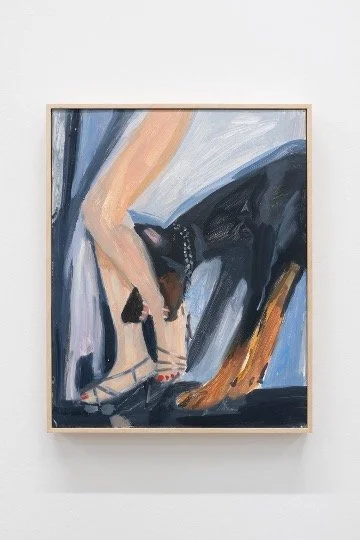
As a final meditation on the role of “negativity” in a corpus as playful and lighthearted as Eastman’s, I want to conclude by taking a closer look at her remarkable Dog Bite (2024): based on a photograph von Wangenheim too for a 1976 Christian Dior campaign (“Fetching is your Dior”). Depicting a thin, tense-faced, heavily bejeweled model (Lisa Taylor) with a seemingly barely controlled Doberman—in one picture, noticeably struggling to hold on to the dog’s collar as it lunges at something outside the frame; in another, screaming tilted backwards on the floor with an elbow lifted against its springing attack—the imagery is undeniably “bold” (fashionistas on Internet platforms also call it “iconic” and the “hardest Dior campaign ever”) and, just as undeniably, very Hustler magazine (the mainstream way of continuously and suggestively pointing to the existence of much harder genres of porn). “Hardness” was not just a period aesthetic but also a signature of von Wangenheim’s work, which attained its cult status in part based on his images of an oiled and naked Gia Carangi “caged” behind a metal fence.
It is not exactly as if none of this is readable from Dog Bite (where, incidentally, two of Eastman’s genres meet [animals and women]). But for all its initiation from a photograph by a branded artist redolent of Nazi porn, the painting seems to inhabit a different world. Vigorously directional brushstrokes converge to combine leg and dog into a single compositional entity—a “chunking” together of victim and aggressor comically undercutting the opposition on which the frisson of the source image depends. The loose, quick nature of the paint handling, moreover, which makes us think about all of the different ways in which seeing is potentially connected to touching, brings out the contrast between the suppression of the dog in the ad campaign and the exuberance of release in Eastman’s diagonal fusions of color and line. If the former highlights restraint, the latter highlights letting go. We end up with a sense of there being almost too many legs in this painting, thanks to the arrays of vertical strokes defining the space between them. Echoing the tiny dabs of red paint forming toenails on the foot of the model, the white teeth in the mouth of the dog end up looking almost dainty.
Dog Bite is a funny painting. (I might even describe it as a joyful painting.) And as generations of artists, activists and comedians know, from Brecht to Mel Brooks to hecklers at Proud Boys parades, nothing ruins the high seriousness of fascist scenography more quickly than comedy. The slightest hint of anything remotely humorous about its carefully built-up scenes of aestheticized cruelty dissolves them into bits of cultural matter which anyone can regather for the making of something different.
Dog Bite is therefore particularly useful for thinking about the aesthetic question posed in Adorno’s essay, which is in turn useful for thinking about Eastman’s practice. For the contrast between Dior ad’s sexualized violence (arguably finally more banal or predictable than “edgy”) and the comical, joyful mischievousness of Eastman’s mimetic transformation of it—the contrast between the moods and therefore worlds of the two pictures—takes the seriousness/lightheartedness dialectic to a certain extreme. But the difference between these poles is also a relation, a point of contact or even touch, as foregrounded by both the title and subject matter of Dog Bite. For what is this a painting of, if not, at several levels, the production of a connection? And moreover, a connection generated in the very medium of aversion and/or negativity itself?
The persistence of this contact with the original image (itself already shaped by several layers of mediation) in the very process of overriding or taking distance from it is reflected in Eastman’s unique style of negation. For once again, while her distinctive way of handling paint—one as noticeably rough as it also looks quick, and therefore, in terms of touch or pressure, light—countermands and reverses the mood of the preexisting image, it does so in a noticeably nonpolemical way (hence the disambiguation of “negation” from “aggression”). If the Dior ad, where aggression prevails, links the eye to a particular way of imagining or feeling touch (as domination and/or pain), Dog Bite disconnects and then reconnects these senses in a completely different way. But also in a way that enables us to perceive or understand something which was arguably in the original image all along. Namely, the fragility of the fascist imagination itself.
Countermood
“Mood” or affective “attunement” (Stimmung) is the horizon of all experience for Heidegger; it is “the ‘medium’ in which our thinking, doing, and acting occurs.” As Jonathan Flatley glosses, there is thus a sense in which mood constitutes “our world at a given moment,” enabling specific affects and objects to come into view, while foreclosing others. It is “only within a mood or by way of mood” that we “encounter things in the world as mattering to us.”
For this reason, Flatley continues, we are never not in a mood: “We only shift from one mood to another, and indeed Heidegger insists that this is the only way that we can exert agency in relation to our moods: ‘When we master a mood, we do so by way of a counter-mood.’” Heidegger does not say much about how counter-moods are generated, notes Flatley. Nonetheless:
He does suggest that such shifts can be brought about by the mundane act of someone walking into a room, someone who brings with her or him a way of being with others such that “irrespective of the sameness of what we do and what we engage in—the way in which we are together is different” . . . But what is it about some people, and the way they import a way of being together, that enables them to shift the mood of a room? What is it about some rooms that render them available for such shifts of mood?
And what is it, we might add, about some painters and paintings? For Eastman’s way of painting operates exactly like “mood” in Flatley’s sense above: in allowing specific relationships and even rhythms to come into view, while blocking the appearance of others, it operates as a “fundamental medium … through which we apprehend the world.” But it seems more precise to say that her way of painting feels first and foremost like a counter-mood: that is, like the resistance or counterforce to another mood which is somehow already prevailing. A counter-mood, we might say, to the felt ponderousness of inherited archives and traditions. (Which as Eastman implies, can only be confronted as opposed to avoided—hence the presence of stylistic “anachronism” and/or preexisting imagery). Or even, perhaps, a counter-mood to the entire present in which we are living.
A handling of paint that is rough (fast, spontaneous, without too much deliberation) but also light (at the level of pressure or touch)—in notable contrast to brushwork which is rough and heavy (Anselm Kiefer), or, conversely, light and controlled (Agnes Martin)—is, finally, a way of handling paint that is evocative of drawing. That is, of drawing’s signature quickness, its inquisitiveness or exploratory nature, and its particular way of connecting seeing to touch—what Jean-Luc Nancy describes as the sensuous but also quasi-cognitive pleasure (or even “compulsion”) of “forming form.”
It is in this manner that Eastman's painting, precisely if also paradoxically as painting, suggests the more nimble, more buoyant, far less traditionally weighted-down “atmosphere” of drawing—and moreover without necessarily proceeding from or incorporating drawing itself (as do De Kooning or Basquiat) or mimetically imitating it (as in Twombly's “blackboard” paintings). We might note here that in her 2025 exhibition at Bombon Projects (Barcelona), Eastman drew on the walls around two of her pictures, speculatively extending their otherwise isolated forms into a shared reality outside the worlds contained by the borders of each individual canvas: adding legs at the bottom and a head to the top of the torso in Lilac Suit; in the case of Mountain Lion, penciling two additional animals on the right side which look like they are in pursuit of the one in the painting. As if to say: Figuratively as well as literally, my painting should be viewed as adjacent to drawing. Even when no drawing is in or underlying it, “drawing” is its spiritual (and interestingly comical) perimeter. Its horizon—or even “mood.”
Painting in the affective key or mood of drawing, with its far greater agility in the act of seeking out form: in conjunction with the other dialectical juxtapositions we have been tracking throughout—anachronism/contemporaneity; negativity/lightheartedness; roughness/delicacy—this feature gets what is most obvious about Eastman’s painting and yet the most difficult to describe. Which is simply how her paintings somehow give us a break—a sense of respite and freedom from the shittiest aspects of our current world and the official artworld especially—without, for all this, becoming “escapist.” For, as we can already surmise based on her tactics of negation, her paintings know fully well that the situation which gave rise to these things is the same to which they also as utopian responses belong.
Notes
1 See Raphael Rubinstein, The Turn to Provisionality in Contemporary Art: Negative Work (London: Bloomsbury Academic, 2023). See also Carrie Rickey, “Naive Nouveau And Its Malcontents,” Flash Art (Summer 1980), 36–9.
2 Bombon Gallery press release.
3 T. J. Clark, The Painting of Modern Life: Paris in the Art of Manet and His Followers (Princeton University press, 1984). On Manet’s Dejeuner as, “of all “modern” paintings, the one raising the most difficult problems for anyone attempting to sort out the links between modern art and tradition,” see Hubert Damisch, trans. John Goodman, The Judgment of Paris (Chicago: University of Chicago Press, 1992), 218.
4 “Painted readymade”: Benjamin Buchloh, “Readymade, Photography, and Painting in the Painting of Gerhard Richter,” in Neo-Avantgarde and Culture Industry (Cambridge: MIT, 2000), 365-404, 375.
5 Damisch. The Judgment of Paris, 219. (Double-check).
6 Theodor W. Adorno, “Is Art Lighthearted?” in Notes To Literature, ed. Rolf Tiedemann, trans. Shierry Weber Nicholsen, intro. Paul A. Kottman (New York: Columbia University Press, 2019), 497-504, 498.
7 On the connection between seeing and touch, see Jacques Derrida, trans. Pascale-Anne Brault and Michael Naas, Memories of the Blind, The Self-Portrait and Other Ruins (University of Chicago Press, 1993). On the interconnectedness of all the senses (as reflected in the intrinsic multiplicity of each individual one), see Jean-Luc Nancy, “Why Are There Several Arts and Not Just One?” in The Muses, trans. Peggy Kamuf (Stanford University Press, 1994), 1-40.
8 “Jonathan Flatley, “How A Revolutionary Counter-Mood Is Made,” New Literary History, Volume 43, Number 3, Summer 2012, pp. 503-525.
9 Heidegger, Being and Time, trans. John Macquarrie and Edward Robinson (New York: Harper and Row, 1962), 175. Cited in Flatley, 507.
10 Jean-Luc Nancy, trans. Philip Armstrong, The Pleasure in Drawing (Fordham University Press, 2013), 15. Even more suggestively for thinking about Dog Bite: Nancy describes drawing as the “coupling of the forming form-force and the formed force-form” (50).